
Female Chaffinch with Bumblefoot

Scaly Leg Mites / Tassle Foot / Depluming Scabies

Scaly Leg is most commonly caused by Knemidokoptes – also spelled Cnemidocoptes, which are eight-legged microscopic mites that are related to spiders, ticks, and scorpions – but obviously much smaller in size.
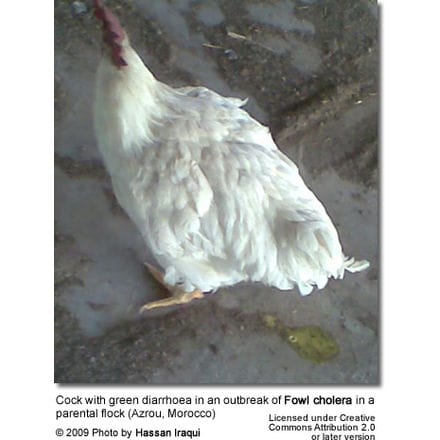
Cock with green diarrhoea in an outbreak of Fowl cholera in a parental flock (Azrou, Morocco)

Avian Goiter (Thyroid Hyperplasia or Dysplasia)

Avian Goiter aka Thyroid hyperplasia is an enlargement of the thyroid glands due to abnormal proliferation of the epithelial cells lining the follicles. The glands are located in the neck region.

Cock with green diarrhoea in an outbreak of Fowl cholera in a parental flock (Azrou, Morocco)

Fowl Cholera

As is suggested by the name, Fowl Cholera disease affects primarily fowl, such as chickens, turkeys, and waterfowl (increasing order of susceptibility). This disease is caused by the bacterial organism, Pasteurella Multocida.

Cryptosporidium / Coccidia

Coccidia are a group of protozoan parasites that are extremely common. Coccidia infection is especially common in young animals housed in groups (in breeding facilities, pet stores, shelters, rescue areas, kennels, etc.) This is a common parasite and is not necessarily a sign of poor husbandry.

Marek’s Disease

If you want to know about Marek’s Disease their prevention, symptoms, diagnosis, supportive nutrition, and treatment options, visit Beauty of Birds.

Sarcocystosis

Sarcocystosis is a disease that affects psittacines, primarily those of Australian, Asian and African origin. It is caused by a protozoan parasite (Sarcocystis falcatula) which is introduced into the aviary by opossums (Didelphis virginiana).

Mice

A few weeks ago we had several mice in the house & all but one were quickly caught.
The remaining mouse would scare my 2 budgies of a night,climb a step ladder close to the cage where seed was spilt etc.
Although the mouse is now gone one of my 2 budgies is scared of bedtime.
He whimpers when it gets dark,when eating and at bed time he panics and whimpers greatly.
Only calms down when is sat with and spoken to but whimpering returns when we leave the room and we don’t want to introduce any habits etc
a night light is in use as he he now terrified of lights out.
Any noise at night scares hi

Pet Sitting

My husband and I are going away for two weeks and will be leaving our two Pionus parrots at home. Their usual sitter will be coming to the house twice a day to feed and clean the cages. Other than that they will be alone. When we are not on vacation we alternate between cage time and free time, however since we will be away, and the birds have a tendency to bite they will not be handled much by the sitter. Should we give our birds the freedom to go in and out of their cages while we are away, or keep them inside for the two weeks?